Why Your Teeth Feel More Sensitive in the First Cold Snap of the Year
Quick Answer: Cold air triggers sensitivity through the same mechanism as cold drinks — fluid movement inside microscopic tubules in exposed dentine — but air hits more teeth at once and dries the surface, which amplifies it. Nothing has newly gone wrong; the trigger simply arrived with the weather. Desensitising toothpaste used correctly (rubbed on, not rinsed off) and breathing through your nose outdoors handle most cases. Sharp, lingering or one-tooth pain is a different problem and needs a dentist.
The first cold morning of the season.
You take a breath through your mouth and your front teeth light up.
Your teeth did not change. The air did.

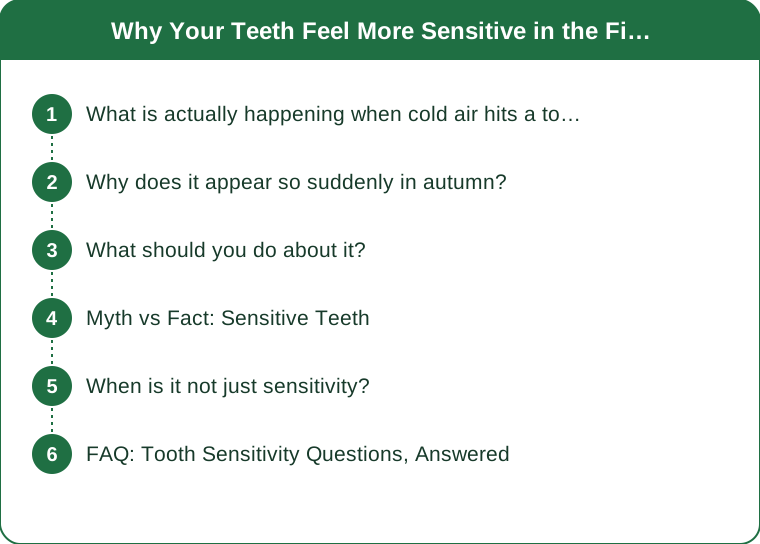
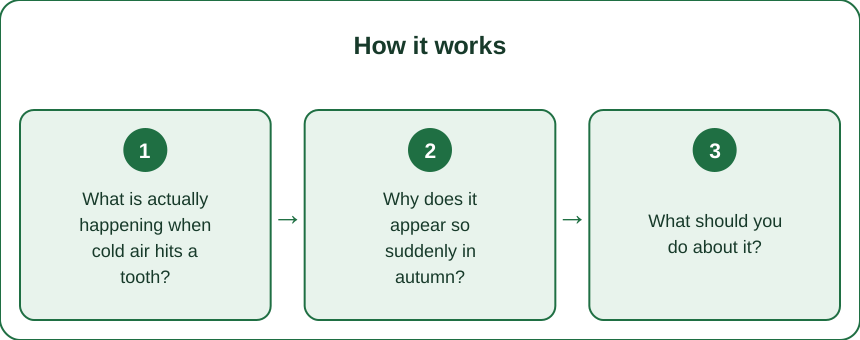
What is actually happening when cold air hits a tooth?
The mechanism is mechanical, not chemical.
Dentine is full of microscopic tubules. Beneath the enamel, dentine is threaded with thousands of tiny fluid-filled channels per square millimetre, running from the surface toward the nerve.
Temperature change moves the fluid. Cold causes the fluid in those tubules to contract and shift rapidly. That movement deforms nerve endings at the inner end — this is the hydrodynamic theory, and it is the accepted explanation for dentine sensitivity.
Air is a worse trigger than water for two reasons. It reaches every exposed surface at once rather than washing over them, and it dries the tooth surface, which itself pulls fluid outward through the tubules. Drying and cooling stack.
Exposure comes from receded gums or worn enamel. Enamel has no tubules and no sensation. Once gums recede or enamel thins at the gumline, dentine is exposed and the pathway opens.
The exposure was already there in July. Cold air is a seasonal trigger acting on a year-round condition, which is exactly why it appears so suddenly and feels like something broke.
Typical pattern: sharp, immediate, gone within seconds of closing your mouth. That profile is characteristic and reassuring.
Why does it appear so suddenly in autumn?
Several things line up in the same few weeks.
The temperature differential jumps. Sensitivity tracks the gap between mouth temperature and the trigger, not the absolute temperature. Your mouth sits near 98°F (37°C), so the first 45°F morning represents a far bigger differential than anything in August.
You breathe through your mouth more. Walking briskly in cold air, exercising outdoors, and autumn congestion all increase mouth breathing, which is what delivers the cold directly.
Dry air dries the surface faster. Cold outdoor air holds less moisture, and heated indoor air is drier still. Both increase surface evaporation from exposed dentine.
Seasonal allergies and colds change your saliva. Congestion, antihistamines and decongestants all reduce saliva flow, and saliva is what naturally remineralises and buffers exposed surfaces.
Grinding often increases with autumn schedule stress, and grinding wears enamel at the gumline — creating new exposure right where it hurts most.
And whitening season begins. Many people whiten ahead of autumn events and holidays. Peroxide-based whitening temporarily increases sensitivity for 24 to 48 hours after each use, and if that lands in the same fortnight as the first cold snap, the two get confused for one problem.
What should you do about it?
Six steps, in order.
Use a desensitising toothpaste properly. Potassium nitrate calms the nerve response; stannous fluoride and arginine formulas physically occlude the tubules. The critical detail: after brushing, rub a little onto the sensitive area with a clean finger and do not rinse. Most people rinse it straight off, which removes almost all of the benefit. Give it two to four weeks of consistent use before judging it.
Do not rinse with water after any brushing. Spit, do not rinse. This keeps fluoride on the teeth and is one of the highest-value habits in dental care.
Breathe through your nose outdoors. Free, immediate, and effective. A scarf over your mouth on the coldest mornings does the same job.
Switch to a soft brush and check your pressure. Hard brushing at the gumline causes recession and abrasion — it creates the exposure rather than cleaning it. Let the bristles do the work.
Wait 30 to 60 minutes after acidic food or drink before brushing. Enamel softens temporarily after acid exposure; brushing straight away scrubs off softened surface.
Pause whitening while it settles. If you are whitening, stop for two weeks and see how much of the sensitivity was that rather than the weather.
This is general information, not dental advice. See a dentist for anything persistent.

Myth vs Fact: Sensitive Teeth
Myth: sensitivity means a cavity. Fact: generalised cold sensitivity across several teeth is usually exposed dentine. A cavity typically produces one specific tooth, often with lingering pain and sensitivity to sweet things.
Myth: harder brushing cleans better and will help. Fact: it is one of the main causes. Abrasion at the gumline plus recession is exactly how dentine gets exposed.
Myth: desensitising toothpaste works immediately. Fact: potassium nitrate needs two to four weeks of consistent use. Judging it after three days is the most common reason people conclude it does not work.
Myth: you should rinse thoroughly after brushing. Fact: spit, do not rinse. Rinsing washes away the active ingredients you just paid for.
Myth: whitening permanently damages enamel. Fact: professionally supervised whitening causes temporary sensitivity, typically resolving in 24 to 48 hours. It is uncomfortable, not destructive.
Myth: nothing can be done about receded gums. Fact: gum tissue does not grow back on its own, but the exposed surface can be sealed and desensitised, and further recession can be stopped. The trajectory is very much changeable.
Myth: sensitivity is just part of getting older. Fact: it is common with age because exposure accumulates, but it is a treatable condition, not an inevitability.
When is it not just sensitivity?
A few patterns mean stop self-treating and book an appointment.
Pain that lingers more than 30 seconds after the cold is gone. Normal dentine sensitivity is sharp and brief; lingering pain suggests pulp involvement.
One specific tooth, consistently. Generalised sensitivity is usually exposure. A single reliable offender is usually something structural — a crack, a failing filling, or decay.
Sensitivity to heat as well as cold. This combination is more concerning than cold alone and should be assessed.
Spontaneous pain, especially at night with no trigger at all. Never a wait-and-see symptom.
Sensitivity to sweetness. Often points toward decay rather than simple exposure.
Visible changes — a notch at the gumline, a chipped edge, gum that has clearly moved, or swelling.
No improvement after four weeks of correct desensitising toothpaste use. Your dentist has in-office options — fluoride varnish, bonding agents, sealants — that are considerably more effective than anything over the counter.
This is general information and not a substitute for professional dental assessment.
FAQ: Tooth Sensitivity Questions, Answered
Why is cold air worse than cold water?
It reaches more teeth at once and dries the surface, and drying pulls fluid through the tubules on its own. Two triggers instead of one.
How long does desensitising toothpaste take?
Two to four weeks of consistent use for potassium nitrate formulas. Occluding formulas can feel quicker but still need consistency.
Should I rinse after brushing?
No. Spit and leave it. This applies to everyone, not just people with sensitivity.
Can I still whiten if my teeth are sensitive?
Usually, with a lower concentration, shorter sessions and a desensitising toothpaste in the fortnight beforehand. Talk to your dentist about the schedule.
Does an electric toothbrush help or hurt?
Helps, if it has a pressure sensor. Most sensitivity from brushing is a pressure problem, and the sensor solves it better than willpower does.
Will the gum grow back?
No, but recession can be halted and the exposed surface treated. In significant cases a dentist may discuss grafting.
Is a mouthguard worth it if I grind?
Yes, if grinding is causing wear at the gumline. It stops the cause rather than treating the symptom.
TL;DR:
- Cold air triggers sensitivity by moving fluid inside dentine tubules — and it dries the surface too, which makes it worse than cold water.
- The exposure existed all summer; the weather supplied the trigger.
- Use desensitising toothpaste rubbed on and not rinsed off, and give it two to four weeks.
- Spit, do not rinse, use a soft brush, and breathe through your nose outside.
- One tooth, lingering pain, heat sensitivity or night pain means see a dentist rather than wait.
Tonight, brush as usual, then rub a smear of desensitising toothpaste on the sore spot and leave it. That one change does more than switching brands.
Keep Reading
This article is for general informational purposes only and is not medical advice. Always consult a qualified health professional for guidance specific to you.