Why Your Teeth Feel Different After a Bad Night of Sleep
Quick Answer: Poor sleep and night-time clenching are tightly linked, and clenching is what makes teeth feel sore, sensitive, or oddly positioned in the morning. Sleep bruxism clusters around the lighter stages of sleep and around arousals, so a fragmented night produces more of it. The morning symptoms — dull ache, temperature sensitivity, a bite that feels wrong — usually fade within a few hours, which is why they get dismissed.
You slept badly, and by mid-morning your back teeth ache and cold water makes you flinch.
By lunchtime it has passed and you forget about it — until the next bad night.

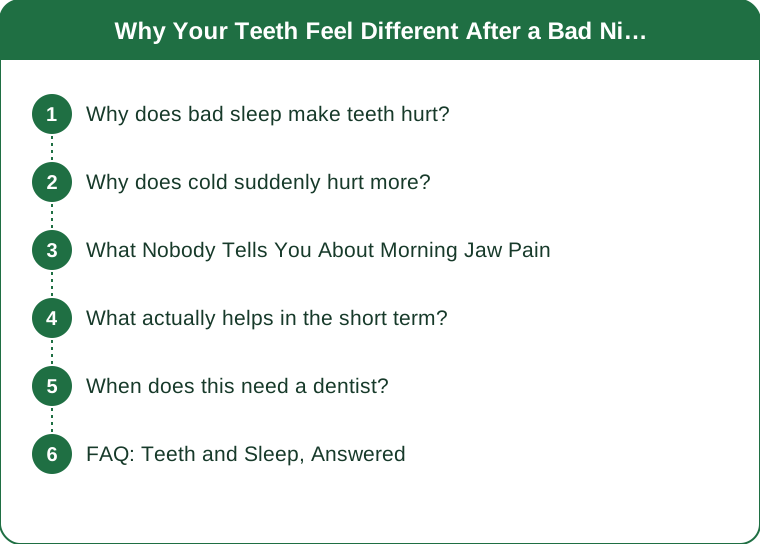
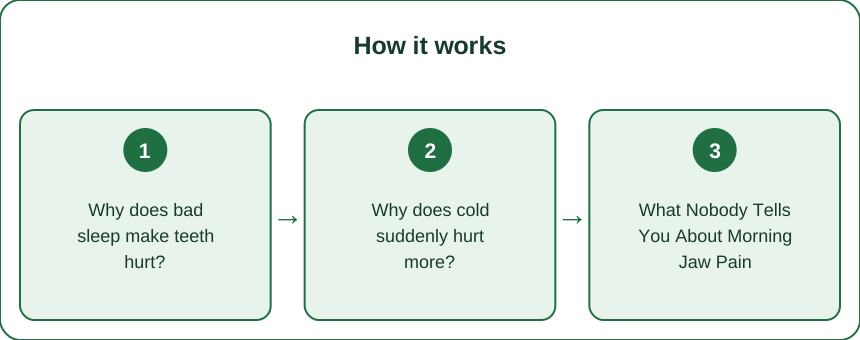
Why does bad sleep make teeth hurt?
Because clenching and grinding happen far more during disturbed sleep than during settled sleep.
Sleep bruxism is associated with brief arousals — the momentary shifts toward lighter sleep that happen many times a night in everyone, and far more often when sleep is fragmented. Each arousal is an opportunity for jaw muscle activity, and a night full of arousals produces substantially more of it.
So the sequence is: poor sleep, more arousals, more clenching episodes, and hours of sustained muscle load on the jaw and teeth.
The force involved is considerable. Voluntary daytime biting force is one thing; night-time clenching is not limited by the discomfort feedback that stops you during the day, and it can be sustained for far longer than you would ever hold a bite awake.
What you feel in the morning is mostly the muscle — the masseter and temporalis working through the night — plus the ligament around each tooth root, which becomes inflamed under sustained pressure and makes teeth feel bruised, loose, or too tall.
Why does cold suddenly hurt more?
Two mechanisms, and they often run together.
Flexing at the gum line. Sustained lateral force makes teeth flex slightly at the neck, where enamel is thinnest. Over time this contributes to small wedge-shaped notches near the gum line, and those areas are much closer to the nerve. Cold reaches them easily.
Ligament inflammation. The periodontal ligament that suspends each tooth becomes inflamed under prolonged load, and inflamed tissue is more reactive to everything, temperature included.
This is why the sensitivity after a bad night is usually diffuse — several teeth at once, often on one side — rather than sharply localised to a single tooth. Sensitivity in one specific tooth that does not fade is a different signal and worth a dental appointment, since that pattern points to a crack, a failing filling, or decay rather than clenching.
The clenching pattern typically eases through the morning as the muscles relax and the ligament settles. The single-tooth pattern does not.
What Nobody Tells You About Morning Jaw Pain
It is usually worse after a stressful day, not during it. Daytime stress reliably shows up as night-time muscle activity, so the sore jaw often arrives the morning after the difficult day rather than during it. People trying to identify a trigger frequently look at the wrong day.
Alcohol is one of the strongest amplifiers. It fragments the second half of the night, which is exactly the mechanism that increases clenching. A single evening drink can produce a noticeably worse morning.
So is caffeine late in the day, for the same reason — anything that lightens sleep increases arousals.
The bite feeling wrong is real, not imagined. Inflamed ligaments make teeth sit fractionally differently, so your bite genuinely does not meet the way it did yesterday. It corrects itself as the inflammation settles, which is why it is worth waiting a few days before concluding a filling is too high.
Headaches at the temples are part of the same picture. The temporalis muscle runs up the side of the head, and a night of clenching produces a dull ache there that gets attributed to tension headache — which, in a sense, it is.
Most people have no idea they do it. Partners notice grinding noise, but silent clenching produces no sound at all and is far more common. The absence of a report from anyone else is not evidence against it.
Nasal congestion makes it worse. Anything that disrupts breathing during sleep increases arousals, and blocked nasal breathing is one of the most common causes. This is part of why the pattern flares during hay fever season and with colds.

What actually helps in the short term?
The morning symptoms respond to fairly simple measures, though none of them address the cause.
Warmth on the jaw muscles. A warm flannel against the masseter for five to ten minutes helps far more than cold. This is muscle pain, and it behaves like muscle pain elsewhere.
Soft food for the day. Chewing something demanding on an already-loaded jaw extends the recovery considerably.
Avoid gum entirely. It is the single worst thing for a jaw that has worked all night, and people reach for it precisely because their mouth feels wrong.
A desensitising toothpaste used consistently, not just on bad mornings, builds up protection over two to four weeks. Applied directly to the sensitive area at night rather than rinsed away works better than brushing alone.
Deliberate jaw rest. During the day, teeth should not touch except when eating — the resting position has a small gap. Most people who clench at night also hold their teeth together during the day without noticing, which prevents any recovery.
A note on painkillers: they will mask the symptom, and for a genuinely painful morning that is reasonable. They do nothing about the load. This is general information, not medical advice.
When does this need a dentist?
Several patterns warrant an appointment rather than management at home.
- Pain in one specific tooth that does not resolve within a day. This is the pattern that indicates a structural problem.
- Visible flattening of the biting surfaces, or teeth that look shorter than they did. This is accumulated wear and is not reversible.
- Notches at the gum line that you can feel with a fingernail.
- Jaw locking, clicking that is new, or difficulty opening fully. This moves into joint territory rather than muscle.
- Morning symptoms most days rather than after bad nights. Frequency changes the picture.
- Loud snoring or witnessed breathing pauses alongside the grinding. Sleep bruxism has a well-documented association with sleep-disordered breathing, and if that is the driver, treating the breathing is what resolves the grinding.
The main protective option is a custom night guard, which does not stop clenching but redistributes the force and protects the enamel. Over-the-counter versions are better than nothing for short-term protection, though a poorly fitting one can alter the bite and make things worse.
Addressing sleep quality directly is the intervention that treats the cause rather than the consequence — and for most people it is the one that gets least attention, because the symptom shows up in the mouth and so the mouth is where they look.
FAQ: Teeth and Sleep, Answered
Can stress alone cause this without bad sleep?
Yes. Stress increases jaw muscle activity independently, and daytime clenching under stress is extremely common. But the two usually travel together, since stress also fragments sleep — which is why a stressful period produces both a bad night and a worse morning.
Will a night guard fix it?
It protects, rather than fixes. Enamel wear stops, and many people find the morning muscle ache reduces as well. The clenching itself continues, so anything driving it — stress, disrupted breathing, alcohol — is still worth addressing separately.
How long should morning sensitivity last before I worry?
If it fades within a few hours and only follows poor nights, that is the typical clenching pattern. Sensitivity that persists all day, wakes you at night, or localises to one tooth should be looked at, and sooner rather than later — those patterns tend to progress.
TL;DR:
- Fragmented sleep produces more arousals, and more arousals mean more night-time clenching — that is the link.
- Morning ache, diffuse sensitivity, and a bite that feels off are muscle and ligament effects, and they usually fade within hours.
- Alcohol, late caffeine, stress the previous day, and nasal congestion all amplify it.
- Warmth, soft food, no gum, and desensitising toothpaste help the symptom; keeping teeth apart during the day helps recovery.
- One tooth hurting persistently, visible flattening, jaw locking, or daily symptoms mean a dental appointment.
The useful thing about this pattern is that it points somewhere other than the mouth. Teeth that feel wrong after a bad night are reporting on the night, not on themselves — and the people who get the most durable improvement are usually the ones who treat it as a sleep problem that happens to present as a dental one.
Keep Reading
This article is for general informational purposes only and is not medical advice. Always consult a qualified health professional for guidance specific to you.