Why Air Conditioning Dries Your Mouth and What It Does to Your Teeth
Quick Answer: Air conditioning removes moisture from the air, and dry air pulls moisture out of your mouth — especially overnight, especially if you breathe through your mouth at all. Saliva is your primary defense against decay: it neutralizes acid, washes away food, and delivers the minerals that repair enamel. Less saliva means acid sits longer on your teeth, which is why a summer of AC often shows up as new sensitivity or new cavities at the fall checkup.
You wake up with a mouth like paper and assume it is a comfort problem. It is a dental problem wearing a comfort problem’s clothes.

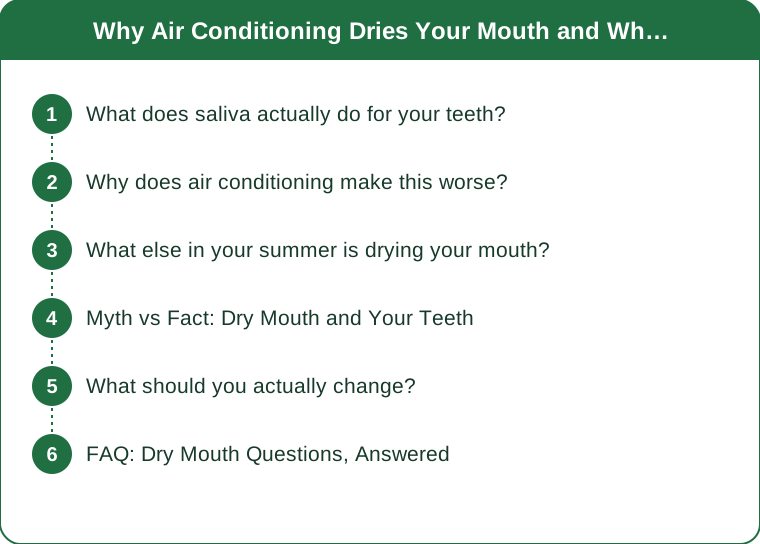
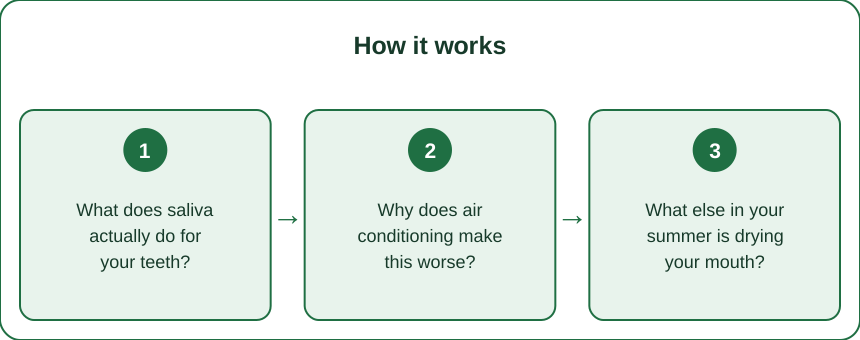
What does saliva actually do for your teeth?
Far more than keeping your mouth wet. It is an active repair and defense fluid.
It neutralizes acid. Every time you eat or drink something acidic — coffee, citrus, soda, wine, even a lot of healthy foods — the pH in your mouth drops and enamel starts to dissolve. Saliva buffers that back to neutral within about twenty to thirty minutes in a normal mouth. In a dry mouth, that can take an hour or more, and enamel is dissolving the entire time.
It delivers repair minerals. Saliva is saturated with calcium and phosphate. When the pH comes back up, those minerals redeposit into the enamel surface — a process called remineralization that is happening constantly in a healthy mouth. Less saliva means less mineral delivery, so the small daily damage stops getting repaired.
It washes. Mechanical rinsing removes food particles and loose bacteria continuously. Without it, debris sits.
It controls bacteria. Saliva contains antimicrobial proteins and enzymes that suppress the bacteria most associated with decay. Those same bacteria thrive in a dry, low-flow environment.
So the short version: saliva is not a byproduct, it is the maintenance system. Reduce it for three months and you have run your teeth without maintenance for three months.
Why does air conditioning make this worse?
Because it dries the air, and it does the most damage during the hours you are least able to compensate.
Air conditioning removes humidity as a side effect of cooling — that is what the condensate line is for. A conditioned bedroom often sits at 30–40% relative humidity, compared to 50–60% outdoors on a summer night. Dry air pulls moisture from every exposed wet surface, and your mouth is one.
The overnight part is what matters. Saliva production drops naturally during sleep to a fraction of daytime levels — this is normal biology, and it is why morning breath exists and why dentists care so much about brushing before bed. Add dry air on top of an already-low-flow period and you get eight hours of essentially unprotected teeth.
Mouth breathing multiplies it dramatically. If you sleep with your mouth even partly open — because of allergies, congestion, or just habit — you are running dry air directly across your front teeth all night. The classic sign is that your upper front teeth are noticeably more sensitive or more prone to decay than the rest of your mouth, because that is where the airflow lands.
And late summer stacks two things. Seasonal allergies peak in August and September in much of the US, congestion pushes people toward mouth breathing, and the AC is still running. The two problems arrive in the same month and compound each other.
What else in your summer is drying your mouth?
Usually several things at once, which is why it adds up faster than people expect.
Dehydration. Heat, sweating, and the fact that most people drink less water than they think. Mild dehydration reduces saliva output before you feel thirsty.
Caffeine, iced and constant. Summer coffee habits tend to be larger and more frequent. Caffeine is mildly diuretic and iced coffee is often sipped over an hour or more, which means an extended acid exposure on top of the drying.
Alcohol. Both directly drying and dehydrating. A summer of more frequent drinks is a summer of lower saliva.
Medications. This is the one people miss entirely. Antihistamines are among the most reliably drying drugs there are, and allergy season is exactly when people take them daily. So are many blood pressure medications, antidepressants, and decongestants. If you started something new this summer, dry mouth is worth checking against the side effect list.
Exercise, especially outdoors. Heavy breathing through the mouth, fluid loss, and often a sports drink involved. Sports drinks are both acidic and sugary, delivered into a mouth with reduced saliva — close to a worst case if sipped slowly over a long session.
Any one of these is manageable. Four of them together for three months is a meaningful change in your oral environment, and it is completely invisible until the checkup.

Myth vs Fact: Dry Mouth and Your Teeth
Myth: Dry mouth is just uncomfortable, not harmful. Fact: Chronic dry mouth is one of the strongest predictors of new cavities in adults, precisely because it removes the buffering and remineralizing functions. Dentists treat significant dry mouth as a high-risk condition, not a comfort complaint.
Myth: Drinking more water fixes it completely. Fact: Water helps a great deal and is the right first move, but water is not saliva. It rinses and hydrates but carries none of the calcium, phosphate, or antimicrobial proteins. If flow is genuinely reduced, you also want to stimulate production rather than only replace volume.
Myth: Sugar-free mints and candies are a good solution. Fact: Sugar-free is better than sugared, but many mints and candies are acidic — citric acid is a common flavoring — and sucking on them delivers a long, low-grade acid exposure to an already dry mouth. Sugar-free gum is a much better choice than sugar-free candy because chewing is what actually stimulates flow.
Myth: Alcohol-containing mouthwash helps with the bad breath from dry mouth. Fact: It masks it and then makes the underlying condition worse, because the alcohol is drying. If your mouth is dry, an alcohol-free rinse is the version that does not work against you.
Myth: A humidifier is only for skin and sinuses. Fact: A bedroom humidifier is one of the most effective and least discussed interventions for overnight dry mouth. It addresses the actual cause rather than the symptom.
What should you actually change?
Five things, roughly in order of return on effort.
Run a humidifier in the bedroom. Target 40–50% relative humidity. A cheap hygrometer tells you whether you are there. This is the highest-value fix because it works during the eight hours you cannot do anything else about, and it helps sinuses and skin at the same time.
Chew sugar-free gum after acidic drinks. Ten minutes of chewing can raise saliva flow substantially, and gum sweetened with xylitol has the additional benefit of not feeding decay bacteria. This is more useful than brushing right after coffee — brushing immediately after acid actually scrubs softened enamel, so wait thirty minutes.
Change how you drink, not just what. Sipping an iced coffee over ninety minutes is far worse than drinking it in fifteen, because each sip resets the acid clock. Use a straw for acidic drinks, and follow with plain water.
Fix the mouth breathing if you can. Treating the congestion that causes it addresses the biggest single driver of overnight dryness. If it persists without congestion, it is worth mentioning to your dentist or doctor — persistent mouth breathing during sleep can be a sign of something worth evaluating.
Ask about a high-fluoride toothpaste. If you have had dry mouth for a season and have a history of cavities, a prescription-strength fluoride paste for nighttime use is a standard and low-effort intervention. Your dentist decides this, not the internet. This is general information, not medical or dental advice.
FAQ: Dry Mouth Questions, Answered
Is it worse to sleep with AC or with the windows open?
For your mouth specifically, windows open is usually more humid and therefore easier on you — but heat disrupts sleep, and bad sleep has its own costs. The better answer is to keep the AC and add a humidifier, which gets you the cool room without the dry air.
Why is only one area of my mouth sensitive?
Airflow and gravity. Upper front teeth take the direct path of mouth breathing and are the least bathed in saliva, so they dry first and worst. Lower front teeth sit right next to a salivary gland duct and are usually the most protected. A pattern of sensitivity concentrated on the upper front is a strong hint that overnight drying is involved.
How long does it take for enamel to recover?
Remineralization of early surface damage happens over weeks to months once the environment improves, and it only works on damage that has not progressed to an actual cavity. Once there is a hole, the enamel does not grow back and it needs a filling. That timing is exactly why acting in late summer is better than waiting for the checkup to tell you.
TL;DR:
- Saliva neutralizes acid, delivers repair minerals, and controls bacteria — dry mouth removes all three
- AC lowers bedroom humidity during the hours saliva production is already at its lowest
- Antihistamines, iced coffee, alcohol, and dehydration stack on top of it all summer
- Humidifier in the bedroom, sugar-free gum after acidic drinks, and treat the congestion that causes mouth breathing
None of this is dramatic on any single night, which is exactly the problem. It is ninety nights of slightly unprotected teeth, and the bill arrives at the fall appointment.
Keep Reading
This article is for general informational purposes only and is not medical advice. Always consult a qualified health professional for guidance specific to you.