Why a Toothbrush Head Stops Cleaning Well Before the Bristles Look Worn
Quick Answer: Bristles lose cleaning effectiveness through loss of stiffness long before they visibly splay. Nylon filaments absorb water, soften, and take a permanent set from repeated bending, so by around 10 to 12 weeks of twice-daily use a head has lost a meaningful share of the flex resistance that lets bristle tips flick plaque out of the gumline. Visible splaying is a late symptom. Replace on the calendar, not on appearance.
Most people replace a head when it looks bad, which reliably means they used a poor one for the last month.
This blog has covered why electric toothbrush pressure sensors get ignored, why your teeth feel rough by the end of the day, and why gums bleed the week you start flossing. Bristle fatigue sits behind all three complaints.

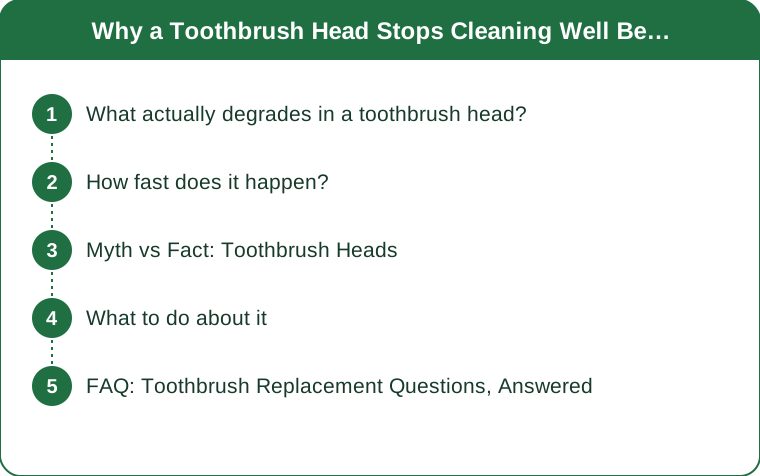
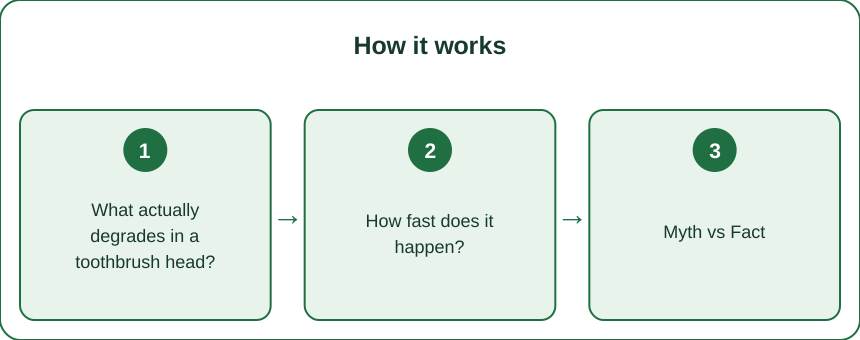
What actually degrades in a toothbrush head?
Stiffness, tip shape, and geometry — roughly in that order, and none of them are obvious to the eye early on.
Nylon bristles absorb a small amount of water and soften. A permanently wet bristle is measurably less stiff than a dry one, and that is the baseline condition of every toothbrush after week one.
Repeated bending produces a permanent set. Each stroke bends the filament; over thousands of strokes it stops returning fully to straight, and it is the return spring that does the actual cleaning work.
Rounded tips wear flat or sharp. Quality heads have polished, rounded filament ends specifically to protect gum tissue, and that rounding wears off with use.
The bristle field loses its designed geometry. Multi-height and angled tufts are engineered to reach the gumline and interdental spaces; once they flatten toward a uniform plane, that reach is gone.
Plaque removal depends on tip contact, not surface pressure. Soft, set bristles glide over the plaque film instead of flicking it away, which is why teeth can feel smooth after brushing but still develop that rough film by evening.
And none of this is visible early. Splaying is what happens after substantial degradation, not the start of it, so appearance is the worst available indicator.
How fast does it happen?
Faster than most people think, and it depends heavily on how you brush.
Twice-daily brushing at reasonable pressure degrades a head meaningfully by around 10 to 12 weeks. That is where the standard three-month guidance comes from, and it is a maximum rather than a target.
Heavy pressure roughly halves that. If you press hard enough to trigger a pressure sensor regularly, assume six to eight weeks.
Grinders and clenchers wear heads faster because dental surfaces are flatter and more abrasive against filaments.
Hot water accelerates it. Rinsing under a hot tap softens nylon; rinse in cool water instead.
Sharing a bathroom cup with other brushes matters less than people fear, but a head stored bristle-down in a closed container stays damp and softens faster. Store upright, uncovered, and let it dry.
And after any illness, replace it early. The reasoning is more about not reintroducing an oral bacterial load than about the flu itself, but the cost is low and the habit is worth keeping.

Myth vs Fact: Toothbrush Heads
Myth: Replace it when the bristles splay. Fact: Splaying is a late-stage symptom. Effectiveness declines gradually from around week eight, so calendar replacement beats visual inspection every time.
Myth: Harder bristles clean better. Fact: Medium and hard bristles remove more gum tissue and more exposed root surface without removing more plaque. Soft is the near-universal recommendation from dental professionals, and technique matters far more than stiffness.
Myth: Generic replacement heads are just as good. Fact: They vary enormously. The specific thing to check is whether filament ends are end-rounded; unrounded ends are noticeably harsher on gum tissue. Some third-party heads are excellent and some are not, so this is worth checking rather than assuming either way.
Myth: An electric brush means you can skip technique. Fact: An oscillating head still needs to be held at the gumline and moved tooth by tooth. Most people move too quickly across the arch and miss the inner surfaces of the lower molars entirely.
Myth: Sanitising the head extends its life. Fact: It may reduce bacterial load but does nothing for filament stiffness, which is the property that actually determines cleaning. It cannot extend a head’s useful life.
Myth: If you brush gently, the head lasts longer. Fact: Gentler brushing helps, but water absorption and filament set happen regardless. Twelve weeks is still the ceiling.
What to do about it
Make replacement automatic rather than a judgement call.
Set a recurring reminder every 10 weeks rather than three months. The extra fortnight of margin covers the degradation you cannot see.
Buy heads in multipacks and keep the next one visible. A spare in the drawer gets forgotten; one on the shelf gets used.
Tie it to something you already track — the start of a season, or the first of every third month — so it does not depend on noticing.
Replace early if you press hard, grind, or have just been ill. Six to eight weeks is the right interval for those.
Check for end-rounded filaments when buying third-party heads, and drop any that feel scratchy on the first use.
And use the pressure sensor rather than overriding it. Almost all the accelerated wear people report comes from pressure, and pressure damages gum tissue at the same time it damages the head.
Store it upright and uncovered to dry. Travel caps are for travel; permanent covers keep filaments soft and shorten the useful life.
FAQ: Toothbrush Replacement Questions, Answered
How often should I really change my toothbrush head?
Every 10 to 12 weeks with normal twice-daily use, and every six to eight if you brush hard, grind your teeth, or have recently been unwell. Do not wait for visible splaying — that indicates the head has been underperforming for some time already.
Do bristles stop working even if they still look straight?
Yes. Nylon filaments soften with constant moisture and take a permanent set from repeated bending, so flex resistance drops well before any change is visible. That flex is what actually removes plaque at the gumline.
Are cheaper replacement heads worth it?
Some are and some are not. The key check is end-rounded filaments, which protect gum tissue. If a head feels scratchy or leaves gums sore, stop using it regardless of price.
This is general information, not dental advice. If your gums bleed persistently or teeth are sensitive beyond a couple of weeks, see a dentist.
TL;DR:
- Bristles lose stiffness through water absorption and permanent bending set long before they visibly splay.
- Replace every 10 to 12 weeks; every six to eight if you press hard, grind, or have been ill.
- Store upright, uncovered, and rinse in cool water — hot water softens nylon faster.
- Soft bristles plus correct technique beat firm bristles at any age of head.
Put it on a recurring reminder. Judging a toothbrush by how it looks is the reason most people are always a month behind.
Keep Reading
This article is for general informational purposes only and is not medical advice. Always consult a qualified health professional for guidance specific to you.