Why a Summer of Iced Drinks Changes How Your Teeth Feel in September
Quick Answer: Iced coffee, sparkling water, and cold citrus drinks are acidic enough to soften enamel temporarily, and a summer of sipping them slowly keeps teeth in that softened state for hours a day. The sensitivity often appears at the end of the season rather than during it, because enamel loss is cumulative and only becomes noticeable once dentin tubules are exposed. The cold isn’t causing it — the acid plus the sipping pattern is.
Your iced coffee habit hasn’t changed since June, but sometime in the last few weeks the first sip started producing a sharp zing. That timing is not a coincidence.

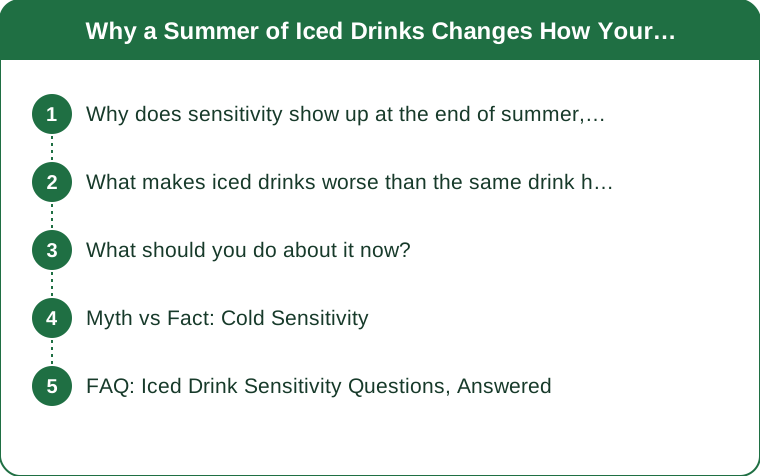
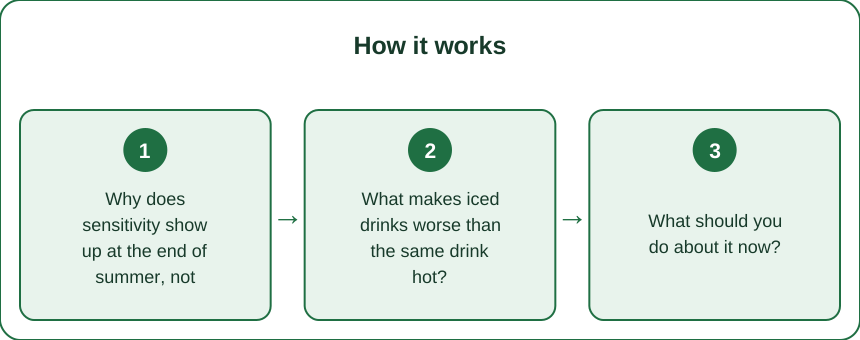
Why does sensitivity show up at the end of summer, not during it?
Because enamel erosion is cumulative and silent until it crosses a threshold.
Enamel has no nerves. Losing a small amount of it produces no sensation at all. The layer underneath — dentin — is riddled with microscopic tubules that connect to the nerve, and sensitivity begins only when enough enamel has thinned for those tubules to register temperature.
That threshold takes months of exposure to reach. Three months of daily acidic drinks is roughly the timescale where a person with otherwise healthy enamel starts noticing. Which is why the complaint lands in late August and September rather than in June.
The cold is a messenger, not a cause. Cold produces a fast fluid shift inside exposed tubules, which the nerve reads as a sharp pain. Warm drinks do it too, more slowly and less noticeably. If cold suddenly hurts, the relevant change happened in the enamel, not in the drink.
Why iced drinks specifically
They’re consumed slowly, over 30 to 90 minutes, which is the real variable — more on that below.
What makes iced drinks worse than the same drink hot?
Almost entirely the pace at which you drink them.
A hot coffee is finished in 10 to 15 minutes. That’s a single acid exposure, after which saliva begins neutralizing and remineralizing.
An iced coffee lasts an hour or more. Every sip resets the acid clock. Saliva never gets an uninterrupted window to bring pH back up, so the enamel stays in a softened state for the whole duration.
Typical pH values put this in context: coffee sits around 5, sparkling water around 5 or below once carbonated, and a lemon or citrus-flavored drink can reach 3. Enamel begins demineralizing below roughly 5.5. Sparkling water is genuinely more acidic than most people assume, and “unsweetened” doesn’t change that — carbonic acid isn’t sugar.
The straw question. A straw positioned behind the teeth genuinely reduces contact with the front surfaces and is worth doing. It doesn’t protect the back teeth, so it’s a partial measure rather than a solution.
The compounding factor is that summer habits stack — iced coffee in the morning, sparkling water through the afternoon, something citrusy in the evening. Any one of these is fine. The combined coverage is what gets you to eight or nine hours a day of softened enamel.

What should you do about it now?
Change the timing more than the drinks, and stop doing the one thing that turns erosion into permanent loss.
Don’t brush right after an acidic drink. This matters more than anything else on the list. Enamel is temporarily softened for roughly 30 to 60 minutes afterward, and brushing during that window physically scrubs away the softened layer. Wait 30 minutes minimum. If you need to brush on a schedule, brush before the coffee rather than after.
Rinse with plain water immediately after. Ten seconds. It raises pH quickly and costs nothing.
Consolidate the sipping. Drinking the same iced coffee across 20 minutes instead of 90 cuts the exposure window by two-thirds without changing what you drink. This is the highest-leverage change available.
Use a fluoride toothpaste, and consider a sensitivity formulation with potassium nitrate or stannous fluoride. These take two to four weeks of consistent use to show effect — people abandon them at day five and conclude they don’t work.
Pair acidic drinks with food or dairy where practical. Cheese and milk raise oral pH meaningfully.
When to see a dentist
Sensitivity in one specific tooth rather than generally, pain that lingers more than 30 seconds after the cold is gone, or any visible notch at the gumline. Those point at something other than general erosion — a crack, decay, or recession — and none of them resolve on their own. This is general information, not medical advice.
Myth vs Fact: Cold Sensitivity
Myth: Sensitivity means you have a cavity. Fact: Generalized cold sensitivity across several teeth is far more often erosion or gum recession. A cavity typically produces localized pain in one tooth and often reacts to sweet as much as to cold.
Myth: Sparkling water is harmless because it has no sugar. Fact: The erosion risk comes from acidity, not sugar. Carbonation produces carbonic acid, and flavored versions frequently add citric acid on top of it.
Myth: Brushing harder cleans better after a sugary iced drink. Fact: Brushing harder during the post-acid softening window removes enamel. Pressure is the enemy here, and it’s the specific mechanism that turns a reversible situation into a permanent one.
Myth: Enamel grows back if you take care of it. Fact: Enamel does not regenerate — it has no living cells. Early demineralization can partially remineralize with fluoride and saliva, but lost thickness is gone. This is why the timing of intervention matters.
Myth: The sensitivity will fade when you stop the iced drinks. Fact: It often improves, because exposed tubules can partially occlude over time. But it improves faster with fluoride and a sensitivity toothpaste than with avoidance alone.
FAQ: Iced Drink Sensitivity Questions, Answered
Is iced tea better than iced coffee for this?
Marginally — most teas are slightly less acidic than coffee, but iced tea is often consumed even more slowly, which cancels the advantage.
Does adding milk to iced coffee help?
Yes, somewhat. Dairy raises the pH of the drink and adds calcium and phosphate. It’s a real if partial improvement.
How long until a sensitivity toothpaste works?
Two to four weeks of twice-daily use. Some people get relief sooner; nobody should judge it at day three.
Should I stop drinking sparkling water entirely?
No. Drink it with meals rather than sipping across the afternoon, and rinse with plain water after. Pattern beats abstinence here.
Will whitening make the sensitivity worse right now?
Almost certainly, yes. Postpone whitening until the sensitivity has settled for a few weeks.
TL;DR:
- Enamel has no nerves, so erosion is silent until dentin tubules are exposed — which is why sensitivity shows up in September, not June
- Slow sipping is the real problem: an hour-long iced coffee keeps enamel softened the entire time
- Never brush within 30 minutes of an acidic drink; that’s when brushing does the most damage
- Rinse with water, consolidate drinking time, and give sensitivity toothpaste a full three weeks
- One tooth hurting, or pain lingering past 30 seconds, is a dentist question, not a habit question
You don’t have to give up iced coffee. You mostly have to stop drinking it for ninety minutes at a time.
Keep Reading
This article is for general informational purposes only and is not medical advice. Always consult a qualified health professional for guidance specific to you.