Why Cold Water Suddenly Started Hurting Your Teeth This Month
Quick Answer: New sensitivity to cold usually points to enamel wear or slight gum recession exposing the more sensitive layer beneath — a sensitivity toothpaste used consistently for 2-3 weeks resolves many mild cases, but it’s worth ruling out a cavity with a dentist first.
Cold water used to be nothing. Now it’s a sharp jolt through one specific tooth. Something changed, even if you can’t pinpoint when.

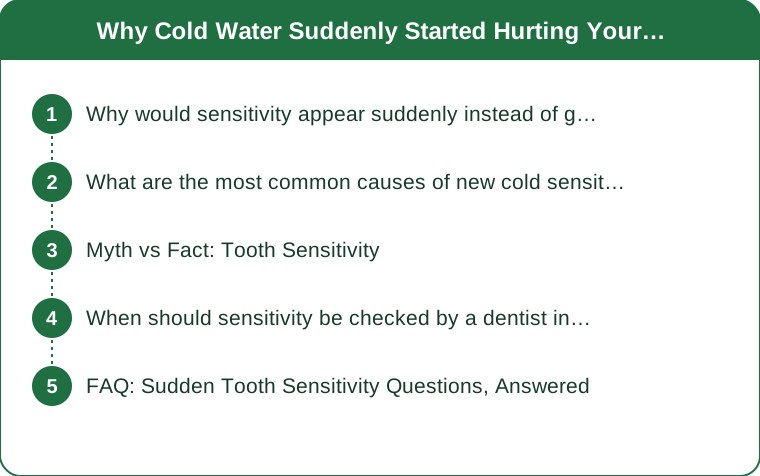
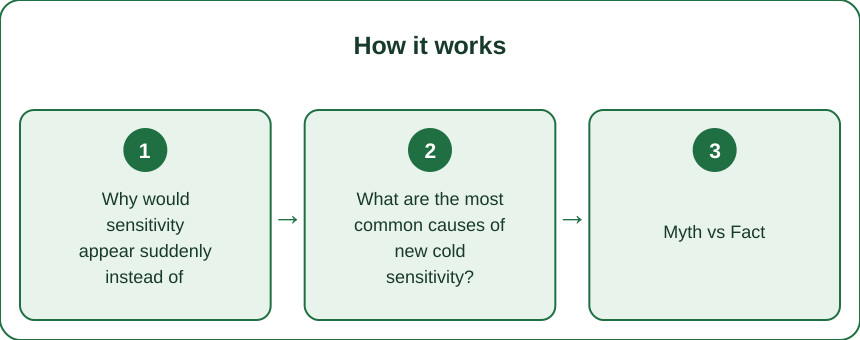
Why would sensitivity appear suddenly instead of gradually?
Sensitivity can feel sudden even when the underlying cause (enamel thinning, minor gum recession, a small crack) has been developing gradually, simply because you cross a threshold where the exposed dentin — the more sensitive layer under enamel — reaches nerve endings enough to register pain. The trigger moment feels sudden; the cause usually isn’t.
A genuinely sudden onset (within days) is more often linked to a specific event — a new whitening product, aggressive brushing, or a cracked filling — while a gradual buildup over weeks points more toward general enamel or gum wear.
What are the most common causes of new cold sensitivity?
Enamel erosion from acidic foods, aggressive brushing, or teeth grinding is one of the most common causes, since thinning enamel exposes dentin more directly to temperature changes. Gum recession, which can happen from brushing too hard or gum disease, exposes the tooth root, an area with no protective enamel at all and significant sensitivity.
A cracked tooth or failing filling is a less common but more urgent cause, since these can worsen without treatment — sensitivity localized to one specific tooth rather than several is a signal worth mentioning to a dentist sooner rather than later.

Myth vs Fact: Tooth Sensitivity
Myth: “Sensitivity always means a cavity.” Fact: while a cavity can cause sensitivity, enamel wear and gum recession are more common causes, especially when sensitivity is generalized across several teeth rather than one.
Myth: “Brushing harder will fix a weak spot faster.” Fact: aggressive brushing is one of the leading causes of the enamel and gum wear that creates sensitivity in the first place — it makes the problem worse, not better.
Myth: “Sensitivity toothpaste works immediately.” Fact: most sensitivity toothpastes need 2-3 weeks of consistent use to build up their blocking effect on the exposed nerve channels — a single use won’t show much difference.
When should sensitivity be checked by a dentist instead of managed at home?
Pain that’s sharp, lingers well after the trigger is removed, or is localized to one specific tooth warrants a dental visit rather than assuming it’s general sensitivity — these patterns are more consistent with a cavity or crack than diffuse enamel wear. Sensitivity that’s new alongside a recent dental procedure is also worth mentioning at a follow-up.
General, mild sensitivity across multiple teeth that responds to a soft-bristle brush and sensitivity toothpaste within a few weeks is less urgent, though still worth a mention at your next routine cleaning.
FAQ: Sudden Tooth Sensitivity Questions, Answered
How long should I try sensitivity toothpaste before seeing a dentist?
Give it about 2-3 weeks of consistent twice-daily use; if there’s no improvement, or the pain is worsening, see a dentist.
Can whitening products cause sudden sensitivity?
Yes, this is a common and usually temporary cause — sensitivity often subsides within a week or two of stopping or reducing use.
Is it normal for sensitivity to affect just one tooth?
It’s less common than generalized sensitivity and worth having checked, since it more often points to a localized issue like a crack or cavity.
TL;DR:
- Sudden-feeling sensitivity often reflects gradual enamel or gum changes crossing a threshold
- Common causes include enamel erosion, gum recession, and less commonly a crack or failing filling
- Sensitivity toothpaste needs 2-3 weeks of consistent use to show real effect
- Sensitivity localized to one tooth warrants a dental visit sooner rather than later
This is general information, not medical advice — see a dentist to rule out a cavity or crack, especially if sensitivity is localized to a single tooth.
Keep Reading
This article is for general informational purposes only and is not medical advice. Always consult a qualified health professional for guidance specific to you.