How to Tell If It's Enamel Erosion or an Actual Cavity Starting
Quick Answer: Enamel erosion tends to cause widespread sensitivity and a smooth, worn appearance across multiple teeth, while an early cavity typically shows as a localized dark spot or rough patch on one specific tooth — the pattern (widespread vs. localized) is often the clearest early clue before a dentist visit confirms it.
Sensitivity to cold shows up, and it’s hard to tell from home whether it’s erosion working its way across your teeth or one cavity quietly starting.

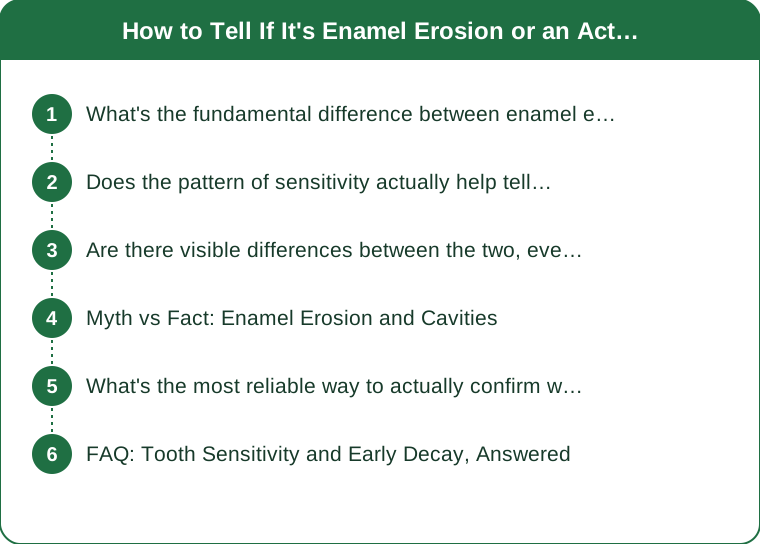
What’s the fundamental difference between enamel erosion and a cavity?
Enamel erosion is a gradual chemical wearing-down of tooth surface from acid exposure (diet, reflux, certain habits) that tends to affect broad areas rather than one isolated spot. A cavity is a localized bacterial process that creates a specific area of decay, usually starting in one spot like a groove or between teeth, rather than wearing down a wide surface evenly.
Does the pattern of sensitivity actually help tell them apart?
Yes, to a useful degree — erosion-related sensitivity tends to affect multiple teeth similarly since the acid exposure isn’t isolated to one spot, while cavity-related sensitivity is often localized to one specific tooth or even one specific side of a tooth, which can be a meaningful early clue before any visible sign appears.
Are there visible differences between the two, even before a dentist exam?
Erosion often produces a smoother, slightly glossy or thinned appearance across the surface of affected teeth, sometimes with minor color changes. A cavity is more likely to show as a distinct dark spot, a rough patch felt with the tongue, or in more advanced cases, a visible small hole — a localized visual change rather than an overall texture shift.

Myth vs Fact: Enamel Erosion and Cavities
Myth: enamel erosion and cavities are essentially the same problem with different names. Fact: they have different causes (chemical wear versus bacterial decay) and often need different prevention approaches.
Myth: sensitivity always means a cavity is forming. Fact: sensitivity is a common symptom of both erosion and cavities, and of several other unrelated issues, so it alone doesn’t confirm which is happening.
Myth: once enamel erosion starts, nothing can be done about it. Fact: while enamel doesn’t regenerate, further erosion can often be slowed significantly with diet and habit changes.
What’s the most reliable way to actually confirm which one is happening?
A dental exam, often including an X-ray for cavities specifically, is the only reliable way to confirm — a cavity in early stages, in particular, isn’t always something that shows a clear enough visible or textural sign to self-diagnose confidently at home.
FAQ: Tooth Sensitivity and Early Decay, Answered
Can enamel erosion lead to cavities over time?
Yes — as enamel thins from erosion, the tooth becomes more vulnerable to decay, since there’s less protective surface between bacteria and the more sensitive layers underneath.
Does diet play a bigger role in erosion or in cavities?
Both are diet-influenced, but through different mechanisms — frequent acidic food and drink drives erosion, while frequent sugar exposure feeding decay-causing bacteria drives cavities.
How soon should sensitivity like this be checked by a dentist?
General guidance is not to wait past the next routine checkup if sensitivity is mild, but to schedule a visit sooner if sensitivity is sharp, persistent, or localized to one specific tooth. This is general information, not medical advice.
TL;DR:
- Erosion tends to be widespread across teeth; cavities tend to be localized to one spot
- Sensitivity pattern (broad vs. localized) is a useful early clue
- Erosion often looks smooth and glossy; cavities often show a dark spot or rough patch
- Enamel doesn’t regenerate, but further erosion can often be slowed
- A dental exam is the only reliable way to confirm which is actually happening
The pattern of what you’re feeling is a useful clue — a dentist visit is the actual answer.
Keep Reading
This article is for general informational purposes only and is not medical advice. Always consult a qualified health professional for guidance specific to you.