Does Mouthwash Actually Do Anything for Your Teeth?
Quick Answer: It depends entirely on which one. Fluoride mouthwash does something measurable — it strengthens enamel and reduces cavity risk, especially for people at higher risk. Antiseptic mouthwash reduces gum inflammation and plaque bacteria. Cosmetic mouthwash — the kind sold mainly on fresh breath — does essentially nothing beyond masking odor for about 20 minutes. And rinsing right after brushing washes away the concentrated fluoride you just applied, which makes the whole routine worse rather than better.
The burn feels like it must be working. That is roughly the entire marketing strategy for one whole category of mouthwash, and it is also the reason a lot of people use it wrong.
Here is the useful distinction: there are three genuinely different products sold under the same word, and only two of them change anything about your teeth. The timing mistake in the last section is one dentists correct constantly, and most people have never heard of it.

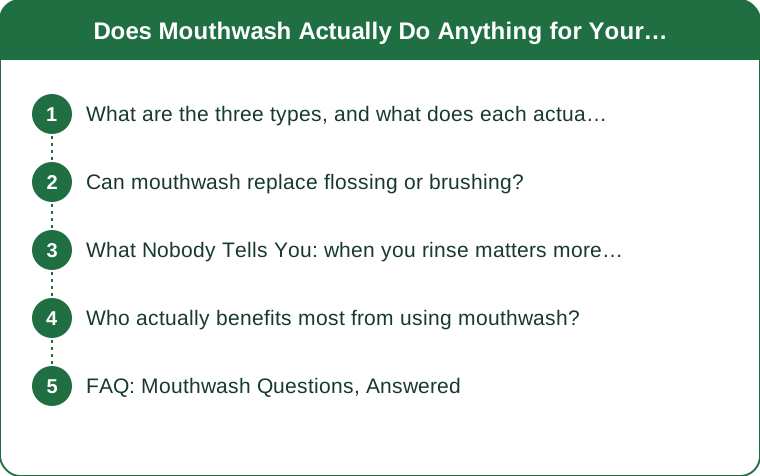
What are the three types, and what does each actually do?
Fluoride mouthwash
This is the one with real evidence behind it. Fluoride rinses deliver additional fluoride to the tooth surface, where it helps remineralize early enamel damage before it becomes a cavity. Reviews of fluoride rinse trials find a meaningful reduction in cavity development, particularly in children and in adults with higher risk — dry mouth, braces, gum recession exposing root surfaces, or a history of frequent cavities.
If you have none of those risk factors and you brush twice daily with fluoride toothpaste, the additional benefit is modest. It is not nothing, but it is an add-on rather than a foundation.
Antiseptic or antibacterial mouthwash
These contain agents like chlorhexidine (prescription), cetylpyridinium chloride, or essential oil blends. They reduce plaque bacteria and gingival inflammation, and the evidence for reducing gingivitis when used alongside brushing is reasonably solid.
Chlorhexidine is genuinely powerful and is usually prescribed for short courses — after periodontal treatment or oral surgery — because extended use causes brown staining and can affect taste. It is not a daily product for most people.
Cosmetic mouthwash
Flavor and a temporary masking effect. No active ingredient that changes plaque, enamel, or gum health. Useful before a meeting, irrelevant to your dental health. If bad breath is your reason for using it and it keeps coming back within the hour, the mouthwash is treating a symptom whose cause is somewhere else.
Can mouthwash replace flossing or brushing?
No, and this is the most consequential misunderstanding about it.
Brushing and flossing are mechanical — they physically disrupt and remove the biofilm stuck to your teeth. Mouthwash is chemical, and it cannot dislodge established plaque. Mature plaque biofilm is structurally resistant to rinses; the outer layer of bacteria may be affected while the layer against the tooth carries on untouched.
The practical translation: rinsing instead of flossing leaves the plaque between your teeth exactly where it was, now smelling better. Rinsing instead of brushing does even less.
The order that makes sense is: floss, brush, and then — if you are using a rinse — use it at a different time of day entirely. More on that in a moment.
If your reason for reaching for mouthwash is that flossing is unpleasant, the better fix is a different tool: floss picks, interdental brushes, or a water flosser all clear interdental plaque, and interdental brushes actually outperform string floss for people with larger gaps.

What Nobody Tells You: when you rinse matters more than what you rinse with
Here is the mistake almost everyone makes.
You brush with fluoride toothpaste. That toothpaste leaves a concentrated layer of fluoride — typically 1,450 ppm — sitting on your enamel, and it keeps working for a while afterwards. Then you rinse with mouthwash, which contains roughly 225 ppm fluoride, or none at all.
You have just washed off a strong fluoride application and replaced it with a weak one, or with nothing.
The same applies to rinsing with water. The current guidance from dental bodies is to spit after brushing and not rinse at all — let the toothpaste residue stay on the teeth.
If you want to use a fluoride mouthwash, use it at a separate time from brushing — after lunch, or mid-afternoon. That gives you two separate fluoride exposures across the day instead of one that cancels the other.
A few other timing points worth knowing:
Do not rinse immediately after anything acidic. After orange juice, wine, soda, or vomiting, enamel is temporarily softened. Rinsing vigorously — or brushing — in that window scrubs away softened mineral. Wait 30 to 60 minutes; rinse with plain water in the meantime if you need to.
Alcohol-based rinses and dry mouth are a bad pairing. Alcohol is drying, and dry mouth is itself a major cavity risk factor because saliva is your primary natural defense. If you have dry mouth from medication, age, or mouth breathing, choose an alcohol-free formula.
Do not eat or drink for 30 minutes after a fluoride rinse. Otherwise you have rinsed for nothing.
Who actually benefits most from using mouthwash?
Some people get a genuine return from it. Others are buying flavored water.
Worth using a fluoride rinse: anyone with braces or other fixed appliances, people with dry mouth, people with exposed root surfaces from gum recession, anyone with a recent history of multiple cavities, and people who find thorough brushing physically difficult.
Worth using an antiseptic rinse, usually short-term: people actively being treated for gingivitis or after oral surgery, on a dentist’s direction rather than indefinitely.
Probably not getting much: a healthy adult with no recession, no dry mouth, few cavities, who brushes twice daily and cleans between their teeth. For this person, mouthwash is a small optional extra, and the money is better spent on interdental brushes or an electric toothbrush head replaced on schedule.
Persistent bad breath, bleeding gums that do not settle within two weeks of consistent flossing, or sudden sensitivity are all reasons to see a dentist rather than reasons to buy a stronger rinse. This is general information, not a substitute for professional dental advice.
FAQ: Mouthwash Questions, Answered
Does mouthwash whiten teeth?
Whitening mouthwashes contain low concentrations of hydrogen peroxide with very short contact time — usually 30 to 60 seconds. That combination produces minimal change compared to strips or professional treatment. They may help slow new surface staining, but they will not lift existing discoloration.
Is the burning sensation a sign it is working?
No. The burn comes from alcohol or from certain flavoring compounds, neither of which is the active ingredient doing the work. Alcohol-free formulas with the same actives are equally effective and considerably more comfortable.
Should children use mouthwash?
Generally not under age six, because of the swallowing risk, and always on a dentist’s advice after that. Children at high cavity risk are sometimes prescribed a fluoride rinse, but supervised brushing with an age-appropriate fluoride toothpaste does the heavy lifting.
TL;DR:
- Fluoride rinses have real evidence, especially for higher-risk mouths; antiseptic rinses help gum inflammation; cosmetic rinses only mask breath.
- Mouthwash cannot replace brushing or flossing — it is chemical, and plaque removal is mechanical.
- Never rinse straight after brushing; you wash off the concentrated fluoride. Use a rinse at a separate time of day.
- Skip rinsing for 30 to 60 minutes after anything acidic, and choose alcohol-free if you have dry mouth.
If you take one thing from this: stop rinsing after you brush. It costs nothing, it takes no extra time, and it is the change most likely to improve what your dentist sees next visit.
Keep Reading
This article is for general informational purposes only and is not medical advice. Always consult a qualified health professional for guidance specific to you.