Does Brushing Harder Actually Clean Better, or Just Wear Your Gums Down?
Quick Answer: Harder brushing does not clean better. Plaque is a soft biofilm removed by contact and technique, not force, and studies of brushing pressure consistently find that above roughly 150 to 200 grams of force, cleaning does not improve while tissue damage does. What excess pressure does produce is gum recession, cervical abrasion at the gum line, and splayed bristles that clean worse - so the harder brusher ends up with both more damage and less plaque removal.
Here is what the right pressure feels like and how to find it without buying anything.

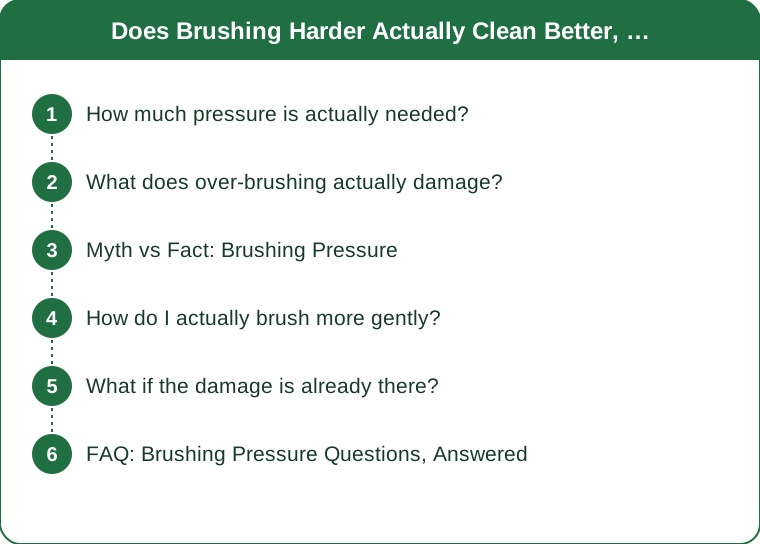
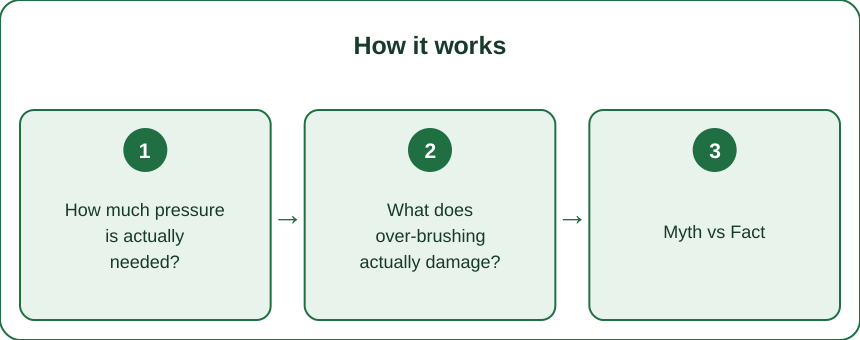
How much pressure is actually needed?
Around 150 grams - roughly the weight of a small apple. That is the figure most electric toothbrush pressure sensors are calibrated around, and it is far less than most people apply.
Most people brush at two to three times that. Studies of habitual brushing pressure regularly find averages well above the optimum, and people are poor at estimating their own - which is why sensors changed behaviour when they appeared.
Plaque is soft enough to wipe off with a finger. It is a biofilm, not a deposit. The difficulty is reaching it, not dislodging it, which is why technique and coverage matter and pressure does not.
Hardened tartar is the exception, and you cannot remove it at home. Calcified deposits need a professional scaler. Scrubbing harder will not shift tartar - it will only damage the tissue around it.
The test is the bristles. Pick up your brush: if the bristles splay outward under normal use, you are pushing too hard. Splayed bristles then fail to reach into the gum margin, so cleaning genuinely gets worse.
What does over-brushing actually damage?
Gums recede, and gum tissue does not grow back. This is the most consequential outcome - once the margin has moved, it has moved permanently, and it exposes root surface that is not protected by enamel.
Exposed root is much softer than enamel - cementum and dentine wear far faster. This is where the classic notch at the gum line comes from, and it is a common cause of sensitivity to cold.
Sensitivity is usually the first symptom people notice. Cold air or cold water hitting exposed dentine produces a sharp, brief pain. If yours appeared gradually rather than suddenly, brushing pressure is a leading candidate.
Enamel wear is a real but slower effect, and it is dramatically accelerated by brushing straight after anything acidic. Enamel softened by acid is far more vulnerable to abrasion - which makes the timing question below more important than the pressure one for some people.
And the brush head wears out much faster. A brush replaced every six weeks instead of every three months is a fairly reliable indicator of excess force - and worn bristles clean measurably worse well before they look obviously frayed.
Myth vs Fact: Brushing Pressure
Myth: medium or hard bristles clean better. Fact: soft bristles remove plaque effectively and are gentler on gums and exposed root. Hard bristles offer no cleaning advantage in the research and considerably more abrasion risk. Soft is the default recommendation for almost everyone.
Myth: bleeding gums mean you should brush more gently there. Fact: bleeding usually indicates inflammation from plaque and typically improves with consistent gentle cleaning of that area, not avoidance. Bleeding that persists beyond a couple of weeks needs a dentist.
Myth: an electric toothbrush is automatically gentler. Fact: only if you let it do the work. Pressing an electric brush into the teeth defeats the mechanism and can be worse than manual brushing. The pressure sensor exists precisely because people press.
Myth: brushing right after breakfast is best. Fact: after anything acidic - fruit juice, coffee, citrus - enamel is temporarily softened, and brushing then increases wear. Wait 30 to 60 minutes, or brush before breakfast instead.
Myth: you can feel whether you are pressing too hard. Fact: people are consistently poor at judging it. Pressure habits are largely unconscious, which is why an external signal - a sensor, or the pen-grip trick below - works better than trying harder to notice.
Myth: more foam means better cleaning. Fact: foam is a surfactant effect and tells you nothing about plaque removal. A brush that foams generously in 20 seconds has not cleaned anything more than one that does not.

How do I actually brush more gently?
Hold the brush like a pen, not like a fist. A pencil grip physically limits how much force you can apply. This single change is the most effective non-equipment fix available.
Use your fingertips, not your arm. Pressure comes from the shoulder and wrist. If your forearm is working, you are pushing. Small movements from the fingers only.
Aim at 45 degrees to the gum line, and think sweeping rather than scrubbing. The bristles should slip slightly into the gum margin - that is where plaque accumulates - and horizontal scrubbing is what causes the abrasion notches.
Slow down and add time instead of force. Two full minutes, split into four quadrants of 30 seconds. Coverage and duration are what improve cleaning, and they are the variables people neglect while over-supplying pressure.
Use a pressure sensor if you have one and stop overriding it. Many people learn to brush just below the alert threshold, which is exactly the point - it is a training tool and it works within a week or two.
And check your brush head monthly. Replace every three months, or sooner if splayed. A splayed head is both a symptom and a cause - it tells you about your pressure and it cleans worse from that point onward.
What if the damage is already there?
Recession does not reverse on its own, but it can be stopped. Correcting pressure and technique halts the progression, which is the realistic goal rather than regrowth.
A dentist can measure it and track it. Recession is recorded in millimetres, so a baseline now means you will know in a year whether it is stable - which is far more useful than guessing.
Sensitivity is treatable. Desensitising toothpaste used consistently over several weeks helps many people, and a dentist can apply fluoride varnish or seal exposed areas where it is more severe.
Abrasion notches at the gum line can be restored with a filling material if they are deep enough to matter. That is a straightforward procedure and it protects the softer root surface underneath.
In more advanced cases, grafting exists, though it is not needed for most people. The main reason to get it looked at is to distinguish brushing abrasion from gum disease, because those need entirely different treatment and can look similar to a non-specialist.
And see someone if you have persistent bleeding, gums pulling away visibly, loose teeth, or sensitivity that worsens. This is general information, not medical advice - a dentist or hygienist can identify the cause in one appointment, which is much faster than working through it at home.
FAQ: Brushing Pressure Questions, Answered
How hard should I be brushing?
Around 150 grams of force - roughly the weight of a small apple. If the bristles splay while you brush, you are well above that.
Do soft bristles really clean as well as medium?
Yes. Soft bristles remove plaque effectively and cause considerably less abrasion to gums and exposed root. There is no cleaning advantage to harder bristles.
Why do my gums bleed when I brush?
Most often inflammation from plaque at the gum margin, which typically improves within a week or two of consistent gentle cleaning. Bleeding that persists beyond that needs a dentist.
Can receded gums grow back?
Not on their own. The realistic goal is stopping further recession, and a dentist can restore abrasion notches or graft in more severe cases.
Is an electric toothbrush better for this?
It can be, mainly because many have pressure sensors that give you feedback you cannot generate yourself. It only helps if you let it do the work rather than pressing it into the teeth.
Should I brush before or after breakfast?
Before is safer if breakfast includes anything acidic - juice, fruit, coffee. Acid softens enamel temporarily, and brushing during that window increases wear. Otherwise wait 30 to 60 minutes.
TL;DR:
- Plaque is a soft biofilm. Above roughly 150 to 200g of force, cleaning stops improving and damage starts.
- The cost is permanent: gum recession does not grow back, and it exposes root surface that wears far faster than enamel.
- Splayed bristles are the giveaway - and they then clean worse, so hard brushers get both damage and worse results.
- Hold the brush like a pen, move from the fingertips, aim at 45 degrees to the gum line, and sweep rather than scrub.
- Add time, not force. Two minutes, four quadrants of 30 seconds.
- Soft bristles for almost everyone, replaced every three months or sooner if splayed.
Persistent bleeding, visible recession, or worsening sensitivity is worth a dentist appointment. This is general information, not medical advice.
Keep Reading
This article is for general informational purposes only and is not medical advice. Always consult a qualified health professional for guidance specific to you.